CRYOGENIC_VITRIFICATION
Cryo-Cooking
The Vitreous Arrest
Transformation by absolute cold. Liquid nitrogen at −196°C extracts thermal energy faster than crystals can organize, arresting the substrate in a glass-like instant.
KINETIC_PROFILE
The circuit runs in reverse: an extreme negative voltage between substrate and cryogen drives a violent extraction current outward. Nucleation is outpaced — water has no time to crystallize and sets as glass.
dT/dt = −(hA / mc) · (T − T∞)Newton's law of cooling — with T∞ = −196°C the gradient is steep enough to outrun crystal growth.
J = J₀ · e^(−ΔG*/kᴮT)Classical nucleation theory — flash extraction denies water the time to organize into large lattices.
ELEMENTAL_SIGNATURE
This transmutation leans air.
ASTROLOGICAL_RULERSHIP
MOLECULAR_INTERACTION
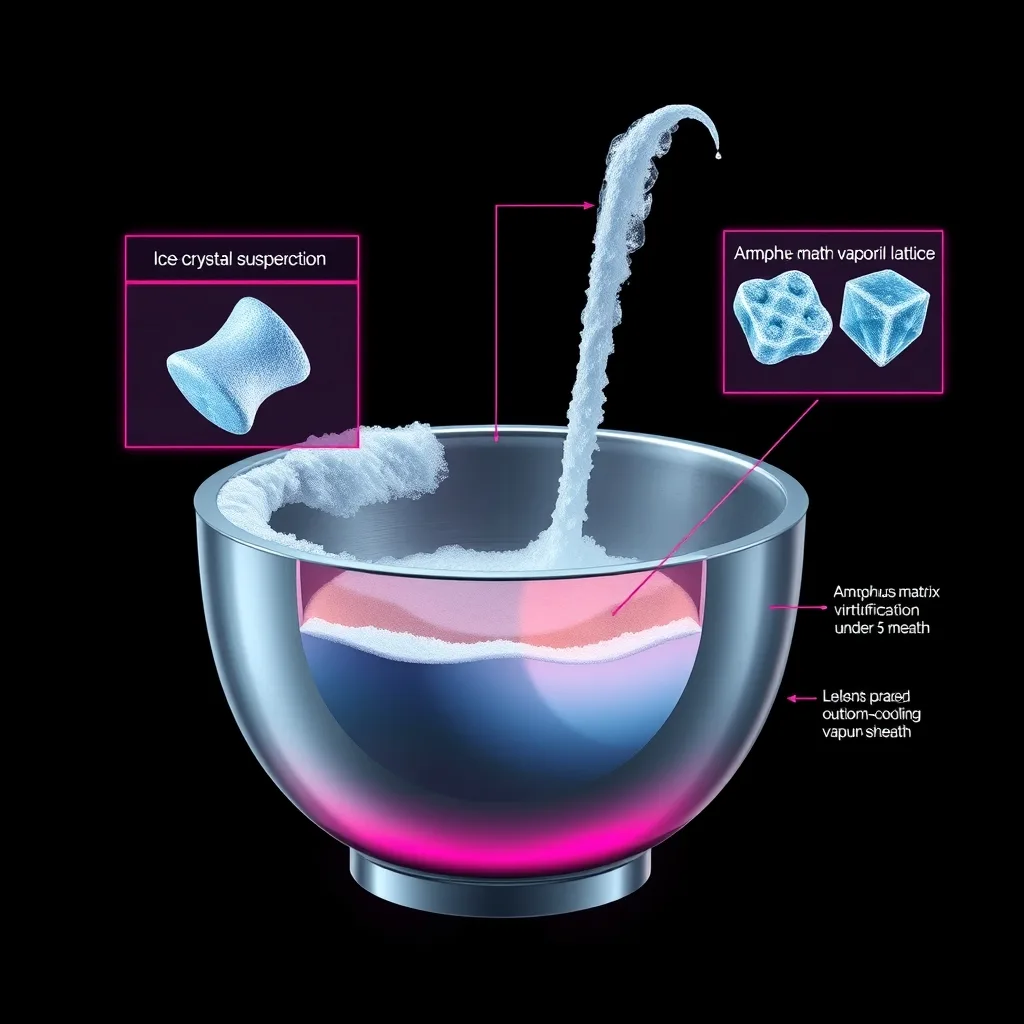
Ice-Crystal Suppression
Heat is extracted faster than water molecules can assemble into large hexagonal lattices. Only micro-crystals form, leaving cell walls unpunctured and texture intact upon the return to warmth.
Matrix Vitrification
Below the glass-transition threshold the concentrated sugar-water phase ceases to flow, setting as amorphous glass rather than crystal. Molecular motion is arrested; decay is suspended.
Leidenfrost Sheath
On contact the cryogen flash-boils, wrapping the substrate in an insulating nitrogen vapor film. The sheath meters the extraction, preventing surface fracture before the core has set.
N₂(l) → N₂(g) (ΔH_vap = 199 kJ/kg)- Ice crystal diameter held below cellular rupture threshold
- Volatile aromatics locked at full potency
- All nitrogen fully vaporized before service
THERMAL_ENVELOPE
Cryogenic flash-freezing typically uses liquid nitrogen (-196°C / -321°F).
PRAXIS
BENEFITS
- Preserves nutrients that might be lost in conventional cooking
- Creates novel textures without additional ingredients
- Can reduce need for additives in frozen desserts
SUITABLE_SUBSTRATES
INSTRUMENTS
- Liquid nitrogen
- Dry ice
- Insulated container
- Safety gloves
- Safety goggles
- Metal bowls
- Insulated utensils
- Anti-griddle (for less extreme applications)
OPTIMAL_TEMPERATURES
ARCHIVES
HISTORICAL_RECORD
Though scientific uses of extreme cold have existed for centuries, cryo-cooking in gastronomy gained prominence in the early 2000s as part of the molecular gastronomy movement. Chefs like Heston Blumenthal and Ferran Adrià pioneered its culinary applications.