PYROLYTIC_INFUSION
Smoking
The Phenolic Veil
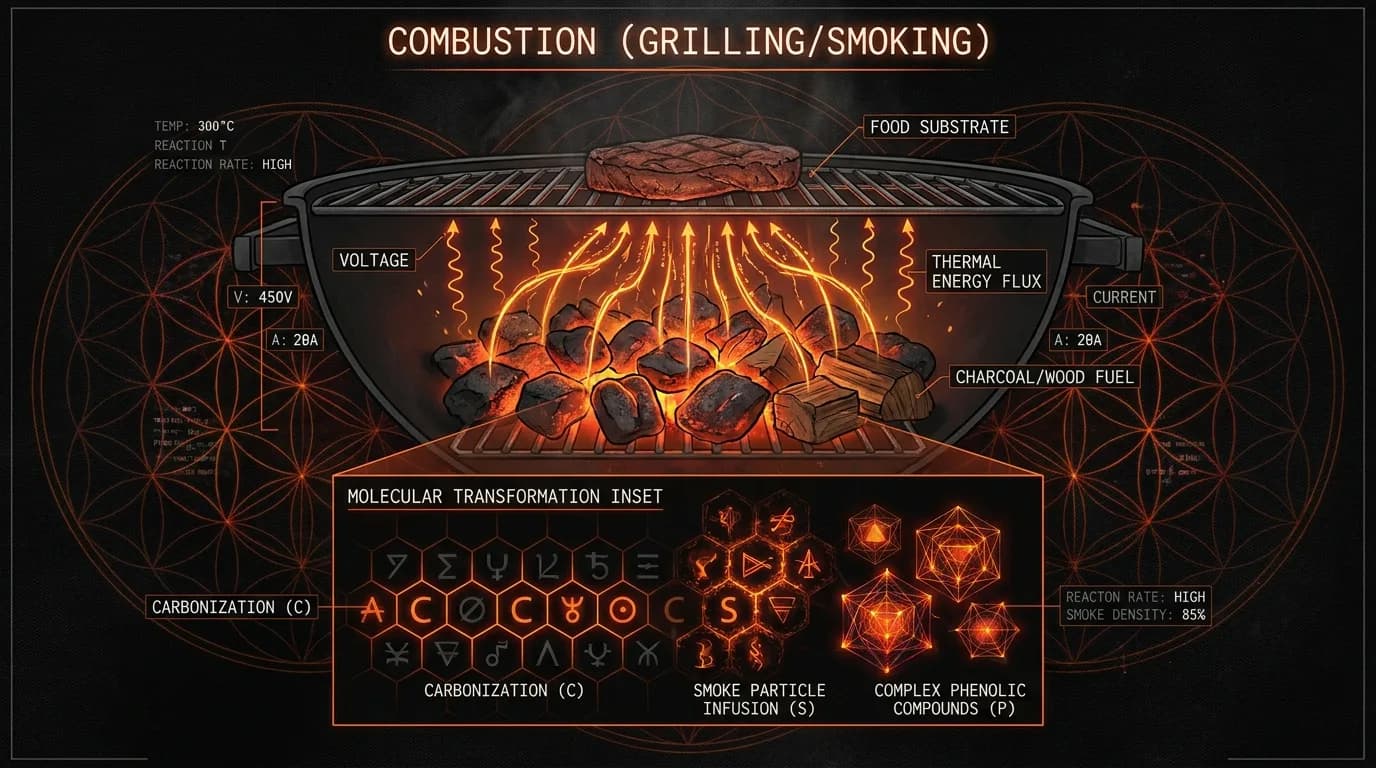
Smoldering wood exhaled over suspended matter. A dense particle current of phenols and carbonyls settles onto the substrate, binding a preservative veil of flavor one molecular layer at a time.
KINETIC_PROFILE
Voltage is deliberately suppressed — the wood must smolder, never flame — while the operative current is a high-density smoke particle flux. Energy arrives second-hand; chemistry arrives first.
Q = mcΔT + Smoke_Infusion_RateTotal transformation couples slow thermal absorption with continuous particulate deposition.
ELEMENTAL_SIGNATURE
This transmutation leans air.
ASTROLOGICAL_RULERSHIP
Orbital alignment dictates aggressive thermal application tempered by expansive smoke exposure.
MOLECULAR_INTERACTION
Phenolic Binding
Guaiacol and syringol deposition altering flavor profile matrices. Lignin pyrolysis releases the phenol family that defines smoke — each compound docking onto surface proteins as both preservative and signature.
C6H5OH → C7H8O2Pellicle Adhesion Layer
A tacky surface film of dissolved proteins — the pellicle — forms during pre-drying and becomes the binding site for the particle current. Without the veil's anchor, smoke slides off unclaimed.
Nitric Oxide Penetration
Combustion gases carry NO into the outer myoglobin band, fixing the rosy smoke ring — a visible record of gas-phase chemistry written into the muscle itself.
< 60°C (ring formation window)THERMAL_ENVELOPE
Cold smoke (~68-90°F) for flavor/preservation; hot smoke (~165-285°F) for cooking.
PRAXIS
BENEFITS
- Adds complex smoky flavor
- Preserves food naturally
- Creates unique texture
- Enhances protein structure
- Provides antimicrobial properties
SUITABLE_SUBSTRATES
INSTRUMENTS
- Smoker
- Wood chips or pellets
- Thermometer
- Rack
ARCHIVES
HISTORICAL_RECORD
Smoking has been used for thousands of years across many cultures as a way to preserve and flavor food, particularly meats and fish. It was an essential preservation technique before refrigeration.