RADIANT_DESICCATION
roasting
The Solar Desiccation
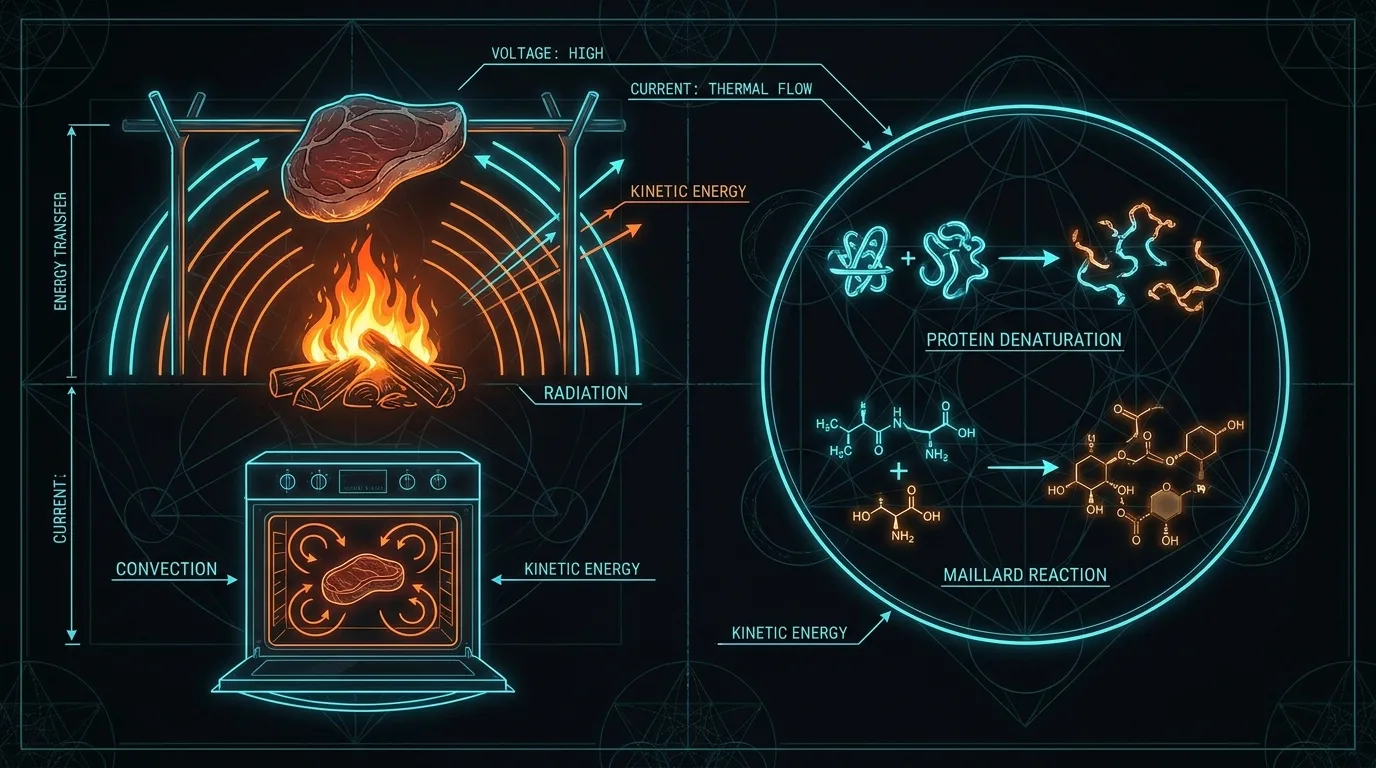
A high-voltage thermal transmutation process relying on radiant and convective heat to achieve complex surface reactions while desiccating the outer membrane.
KINETIC_PROFILE
High radiation-flux voltage (V) sustained by a moderate convective current (I). As bound moisture is driven off, the elemental ledger swings hard positive toward Fire while hydrous Air is expelled as a negative flux.
V(t) = High [Radiation Flux]I(c) = Moderate [Convection Flow]ELEMENTAL_SIGNATURE
This transmutation leans fire.
ASTROLOGICAL_RULERSHIP
MOLECULAR_INTERACTION
Protein Denaturation
Unfolding of tertiary structures, exposing hydrophobic cores. Structural matrix tightens, expelling hydrous elements.
120°C – 160°CMaillard Reaction
Non-enzymatic browning. Amino acids interact with reducing sugars to create complex melanoidins and volatile aromatic compounds.
> 140°CTHERMAL_ENVELOPE
Dry radiant/convective oven heat; surface browning peaks above ~300°F.
PRAXIS
BENEFITS
- enhances flavor through browning
- creates texture contrast
- renders fat
- tenderizes tough cuts
- concentrates flavors
- creates appetizing aromas
SUITABLE_SUBSTRATES
INSTRUMENTS
- Oven or fire source
- Roasting pan/sheet with rack
- Digital meat thermometer
- Kitchen twine (for trussing)
- Basting brush or bulb
- Fat separator for drippings
- Carving board with juice groove
- Instant-read thermometer
- Heavy-duty aluminum foil
- Roasting bags (optional)
COMMON_FAILURES
- Oven too hot (causing outer burning before interior cooks)
- Not resting meat after roasting (leading to dry texture and juice loss)
- Overcrowding the pan (creates steam instead of browning)
- Inconsistent piece sizes (results in uneven cooking)
- Incorrect temperature monitoring (relying on time only)
- Opening the oven door too frequently (causing temperature fluctuations)
- Not preheating the oven sufficiently
- Roasting cold meat straight from refrigerator
EXPERT_DIRECTIVES
- Dry brine large cuts with salt 24-48 hours before roasting for improved moisture retention and flavor penetration
- Create a three-zone fire for outdoor roasting: hot zone for searing, medium zone for cooking, cool zone for resting
- Let meats come to room temperature for 30-60 minutes before roasting to ensure even cooking
- When roasting whole poultry, start breast-side down and flip halfway through for even cooking
- Use a V-rack for meats to allow air circulation and prevent sogginess on the bottom
- For perfect crackling on pork, ensure the skin is completely dry before roasting and score in a diamond pattern
- Add liquid to the bottom of the roasting pan when cooking large cuts to maintain humidity and create sauce base
- Rest roasted meats on a warm plate tented with foil for approximately 10 minutes per pound
REGIONAL_VARIANTS
- MEDITERRANEAN herb-infused olive oil roasting, spit roasting with lemon and oregano, clay pot roasting
- FRENCH high-temperature poultry roasting (poulet rôti), en cocotte with aromatics, gigot d'agneau (leg of lamb with garlic)
- CHINESE char siu technique with honey glaze, Peking duck roasting with air-dried skin, clay oven roasting
- SOUTH AMERICAN churrasco with rock salt crust, pachamanca earth oven roasting, chicha-marinated roasts
- MIDDLE EASTERN slow roasted lamb with sumac and za'atar, pomegranate-glazed poultry, saffron-infused roasting
OPTIMAL_TEMPERATURES
SAFETY_SIGILS
- Use internal temperature monitoring for proper doneness (poultry 165°F, ground meat 160°F, whole cuts to desired doneness)
- Proper ventilation for smoke and fat vapors
- Heat-resistant utensils and protection (silicone or high-temp mitts)
- Safe oil temperature management (below smoke point)
- Prevention of cross-contamination between raw and cooked foods
- Proper storage of leftovers within 2 hours
ARCHIVES
HISTORICAL_RECORD
Roasting is one of humanity's oldest cooking methods, dating back to the discovery of fire approximately 1.8 million years ago. Archaeological evidence shows spit roasting was common in ancient civilizations throughout Mesopotamia, Egypt, and China. Medieval Europe developed sophisticated roasting techniques, including specialized turnspits operated by servants or even dogs. The 18th century saw innovations like the tin reflector oven, while the 19th century brought reliable temperature-controlled roasting in cast iron stoves. The development of gas and electric ovens in the 20th century standardized roasting temperatures, while the late 20th and early 21st centuries have seen a renewed interest in traditional methods including wood-fired ovens, rotisserie cooking, and precision temperature control with digital technology.
SCIENTIFIC_PRINCIPLES
- Maillard reaction creates hundreds of flavor compounds at 280°F-330°F through amino acid-sugar interactions
- Caramelization of sugars occurs at 320°F-360°F, forming new aromatic compounds
- Radiant heat transfer from oven walls to food surface creates gradient cooking
- Fat rendering at 130°F-200°F carries flavor compounds and promotes juiciness
- Dehydration of surface creates flavor concentration and textural contrast
- Collagen conversion to gelatin begins at 160°F in moist heat environments
- Convection currents in heated air circulate to promote even cooking
- Heat shock proteins activated at specific temperatures contribute to texture changes