CONDUCTION_IMPULSE
Stir-Frying
The Kinetic Impulse
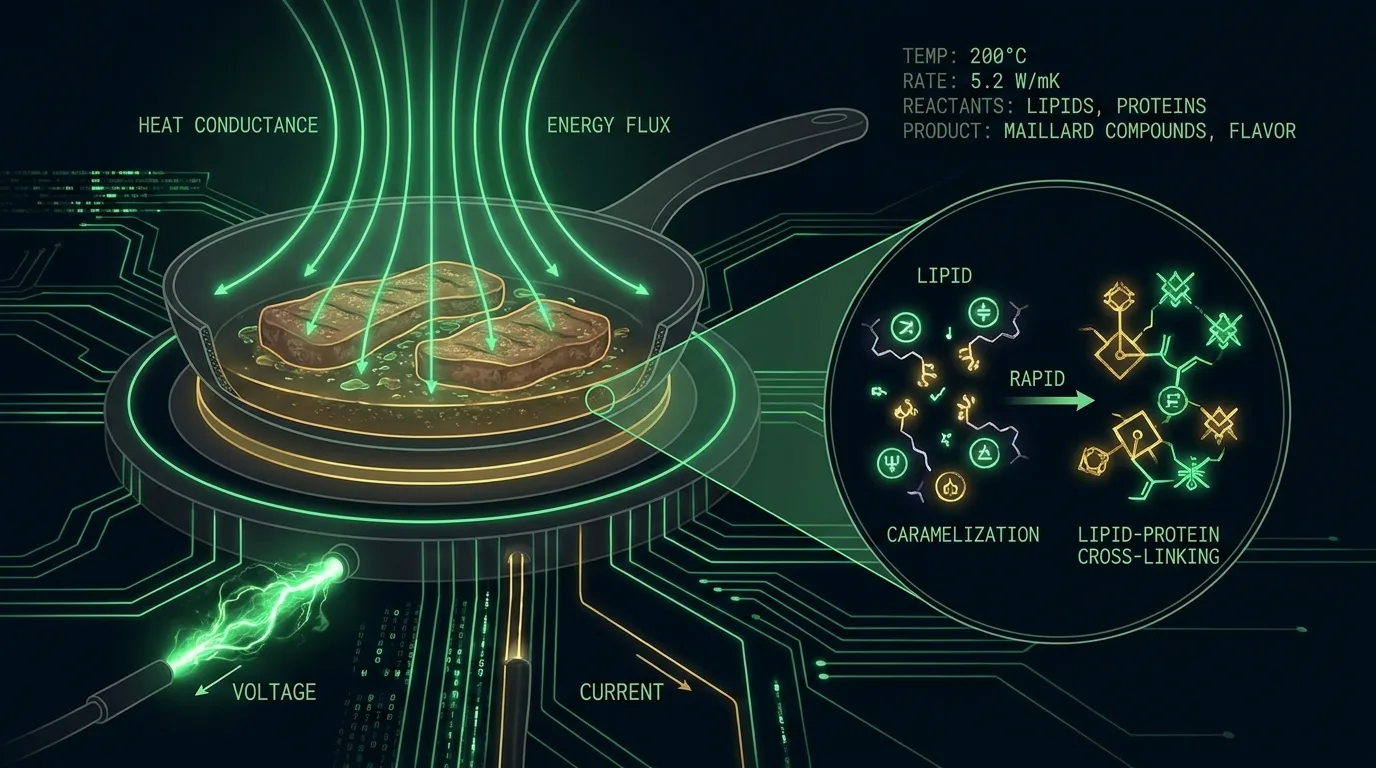
A high-velocity conductive assault delivered through a thin lipid film. Constant agitation cycles every surface across the searing contact zone before interior moisture can migrate.
KINETIC_PROFILE
Intense contact voltage (V) discharged through a rapid lipid-flux current (I), catalyzed by thermal shock. The impulse is brief by design — energy transfer outruns moisture migration, locking structure and color in place.
q = −k∇TFourier's law — heat flux flows down the steep thermal gradient at the metal–substrate contact plane.
ELEMENTAL_SIGNATURE
This transmutation leans fire.
ASTROLOGICAL_RULERSHIP
MOLECULAR_INTERACTION
Rapid Lipid Interaction
The application of intense localized heat induces Rapid Lipid Interaction. Fats denature and form complex volatile aromatic compounds instantly upon surface contact.
Caramelization
Sucrose fragments under dry contact heat, shedding water and recombining into caramelans and volatile furans at the searing interface.
C12H22O11 → C12H20O10 + H2O> 160°CTHERMAL_ENVELOPE
High pan-wall temperatures with rapid tossing and short dwell time.
PRAXIS
BENEFITS
- preserves crunch
- quick nutrient retention
- wok hei flavor
- minimal oil usage
- color preservation
- caramelization
SUITABLE_SUBSTRATES
INSTRUMENTS
- Wok or high-sided pan
- Spatula or wok ladle
- High-heat burner
- Prep bowls for ingredients
- Sharp knife for thin cutting
COMMON_FAILURES
- overcrowding the wok
- inconsistent cutting sizes
- inadequate preheating
- stirring too seldom
- improper ingredient staging
REGIONAL_VARIANTS
- CHINESE bao technique, yángchǎo, Cantonese quick-fry
- JAPANESE teppanyaki style, yakisoba technique
- THAI pad phak, pad see ew technique
- KOREAN bokkeum, chapchae preparation
OPTIMAL_TEMPERATURES
SAFETY_SIGILS
- Use proper ventilation
- Keep handle positioned safely
- Use heat-resistant gloves
- Beware of oil splatter
- Proper wok handling techniques
ARCHIVES
HISTORICAL_RECORD
Stir-frying originated in China during the Han dynasty (206 BCE–220 CE) as a technique to cook food quickly while conserving fuel. The wok rounded shape and the continuous stirring motion allow for rapid, even cooking and the development of wok hei (breath of the wok) - a complex smoky flavor.
SCIENTIFIC_PRINCIPLES
- Thermal conductivity of thin metal wok allows rapid heat transfer
- Continuous motion prevents burning while promoting browning
- Steep sides facilitate tossing without spilling
- Sequential ingredient addition based on cooking time
- Maillard reaction at high temperature creates complex flavors
- Quick cooking preserves texture and nutrients