AQUEOUS_TRANSMUTATION
braising
The Aqueous Transmutation
The methodical synthesis of moisture and sustained thermal energy, inducing deep structural breakdown of dense organic matrices.
KINETIC_PROFILE
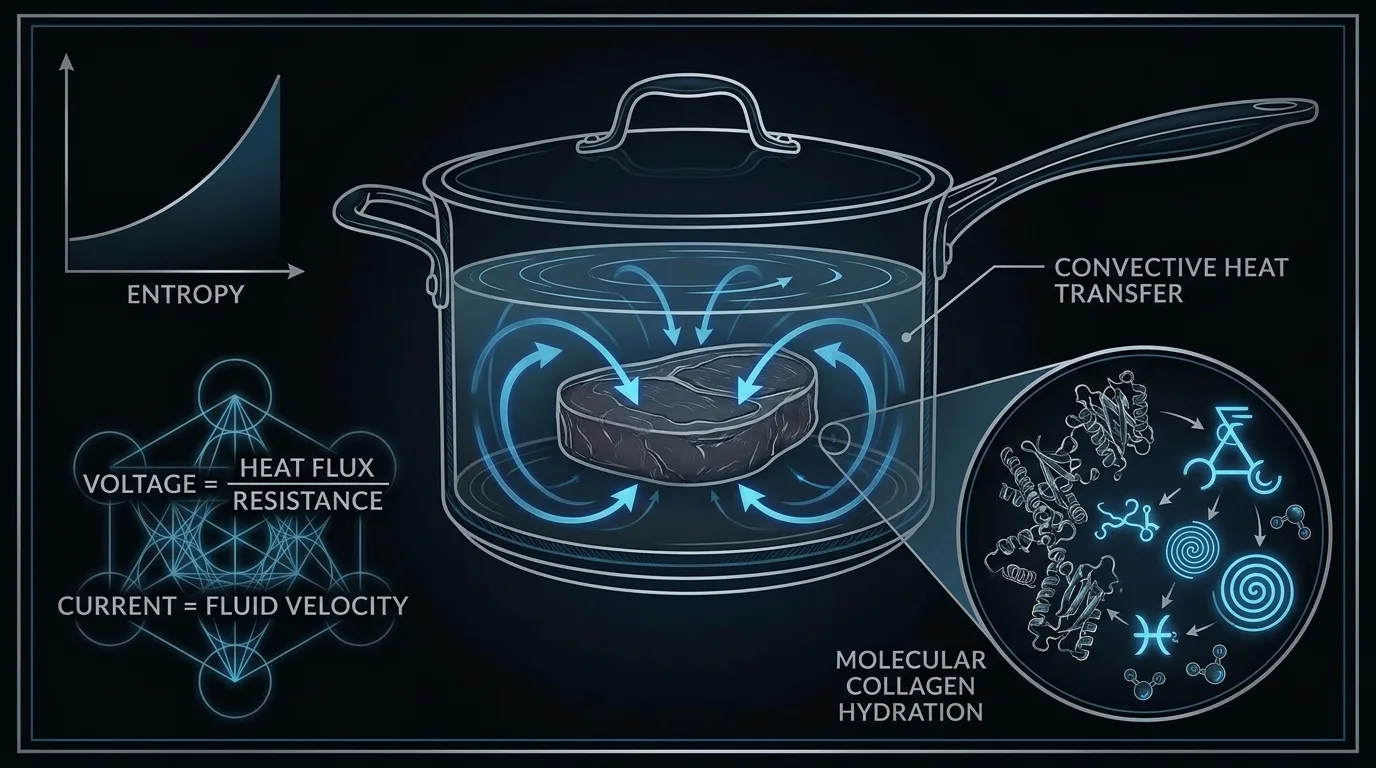
A low, constant thermal voltage drives a fluid convective current through the sealed vessel. Energy delivery is patient and total: the medium cycles endlessly, carrying heat into the densest matrices without scorching the boundary layer.
ΔT = Q / (m · c)Temperature rise of the braising medium per unit of absorbed energy.
Rate = k[H2O][Organic]ELEMENTAL_SIGNATURE
This transmutation leans water.
ASTROLOGICAL_RULERSHIP
MOLECULAR_INTERACTION
Collagen Breakdown & Hydration
Prolonged thermal exposure in an aqueous medium initiates the hydrolysis of dense connective tissues. Triple-helix collagen structures denature, unraveling into hydrophilic gelatin chains, profoundly altering textural integrity.
Bidirectional Flavor Exchange
The sealed convective loop runs an equivalent exchange: soluble compounds leach outward into the braising liquor while aromatic volatiles infiltrate the loosened matrix. Neither phase survives unchanged.
THERMAL_ENVELOPE
Two-stage sear then covered moist cook near simmer range.
PRAXIS
BENEFITS
- tenderizes tough foods
- develops complex flavors
- creates rich sauces
- minimal monitoring once started
- infuses aromatics
- converts collagen to gelatin
- extracts bone marrow nutrients
- concentrates umami compounds
SUITABLE_SUBSTRATES
INSTRUMENTS
- Dutch oven or heavy-bottomed pot with lid
- Tongs
- Wooden spoon
- Aromatics (herbs, spices, mirepoix)
- Heat source (oven or stovetop)
- Kitchen twine (for tying bundles)
- Cheesecloth (for bouquet garni)
- Meat thermometer
- Fine mesh strainer
- Fat separator (for finishing sauce)
COMMON_FAILURES
- too much liquid (should cover only 1/2 to 2/3 of ingredients)
- cooking too fast (higher heat toughens protein)
- lid not tight-fitting (allows excessive evaporation)
- inadequate initial browning (misses Maillard flavors)
- underseasoning (slow cooking mutes flavors)
- not letting meat rest before serving (texture compromise)
- cutting pieces inconsistently (uneven cooking)
- overcrowding during searing phase (steaming instead of browning)
REGIONAL_VARIANTS
- FRENCH boeuf bourguignon (beef in red wine), cassoulet (bean and meat casserole), daube provençale (beef stew with olives and orange), navarin d'agneau (lamb stew with spring vegetables)
- ITALIAN osso buco (veal shanks), brasato al barolo (beef braised in wine), pollo alla cacciatora (hunter's chicken)
- CHINESE hong shao rou (red-braised pork belly), lu rou (braised minced pork), dongpo rou (braised pork belly)
- MEXICAN barbacoa (slow-cooked meat), chile colorado (red chile braised beef), pollo en mole (chicken in complex sauce)
- MOROCCAN tagine (slow-cooked stews), mrouzia (lamb with honey and spices), tangia (slow-cooked meat dish)
OPTIMAL_TEMPERATURES
SAFETY_SIGILS
- Handle heavy pot with care (ergonomic lifting)
- Use oven mitts for hot lids and handles
- Avoid steam burns when opening (direct steam away)
- Proper food temperature monitoring (minimum 165°F for safety)
- Gradual temperature changes (prevents thermal shock)
- Cool large braises properly (within food safety guidelines)
ARCHIVES
HISTORICAL_RECORD
Braising has ancient origins across many cultures and was particularly refined in French cuisine with dishes like cassoulet and coq au vin. It evolved from the need to tenderize tough, less expensive cuts of meat, making it historically significant for working-class cooking. The technique appears in Roman cookbooks dating to the 1st century AD, with Apicius describing several braised dishes. Medieval European cooking featured braising in lidded clay vessels, while Chinese culture developed master-stock braising dating back to the Zhou dynasty. In colonial America, the 'New England boiled dinner' emerged as a braised one-pot meal, while French culinary codification in the 18th and 19th centuries established braising among the grand techniques of classical cuisine.
SCIENTIFIC_PRINCIPLES
- Initial Maillard reaction develops base flavors via high-heat searing
- Collagen converts to gelatin at 160°F-180°F when moisture is present
- Flavor compounds are both water and fat-soluble, extracted by mixed medium
- Low simmer prevents protein toughening while allowing collagen breakdown
- Aromatic compounds infuse throughout cooking liquid
- Convection currents in liquid distribute flavors evenly
- Hydrolysis of connective tissues occurs optimally at 190°F-205°F
- Enzymatic breakdown continues until proteins denature around 160°F