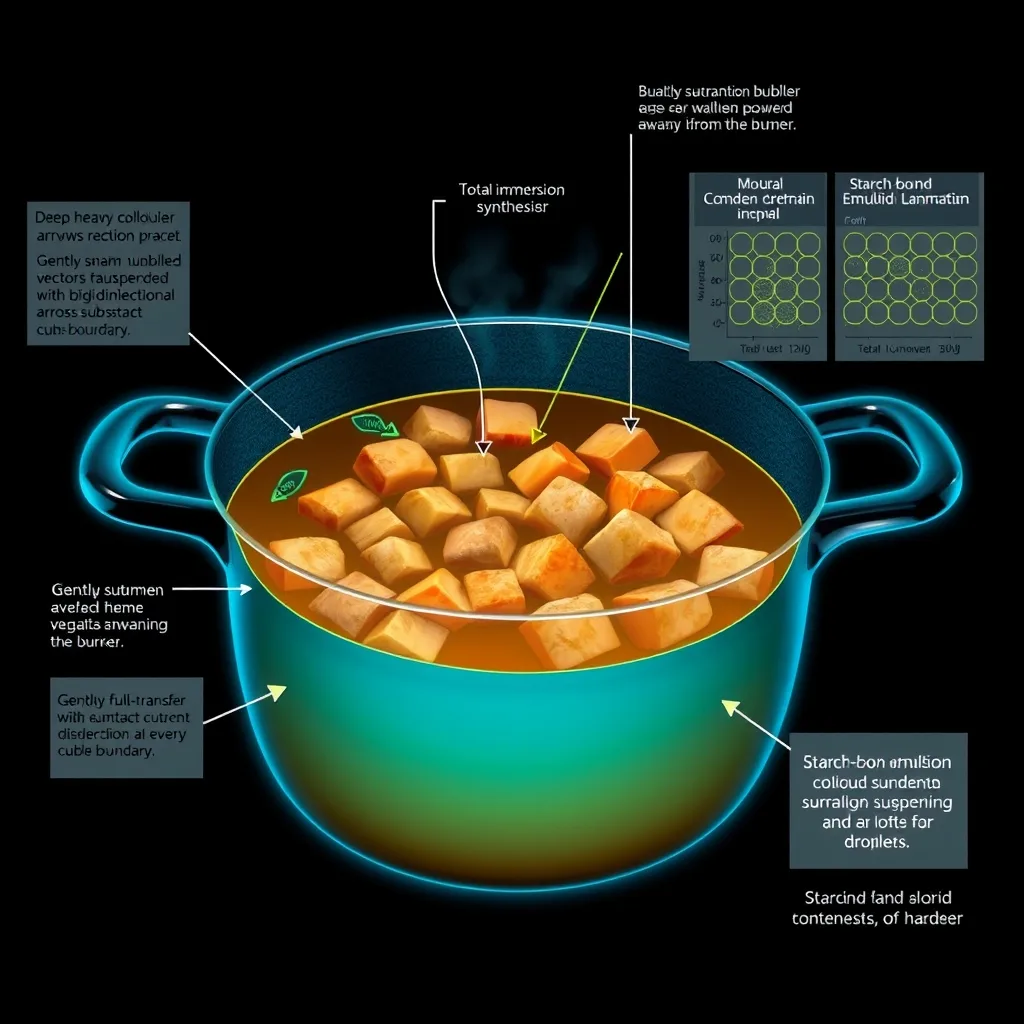
TOTAL_IMMERSION_SYNTHESIS
stewing
The Unified Dissolution
Small matter, fully submerged, surrendered to the medium over hours. Substrate and liquid abandon their separate identities and converge into a single unified body.
KINETIC_PROFILE
A low sustained voltage applied through a current that touches every surface at once — total immersion means no shadowed faces, no gradients of exposure. The exchange runs to completion in both directions.
C_broth(t) → C_solid(t)Solute concentrations of medium and substrate converge as t → hours.
ELEMENTAL_SIGNATURE
This transmutation leans water.
ASTROLOGICAL_RULERSHIP
MOLECULAR_INTERACTION
Mutual Saturation
Cut small and drowned deep, the substrate's full surface area trades with the medium until neither holds an advantage. The stew is the only preparation where the liquid is not a vehicle but a co-equal product.
Starch-Bound Emulsion
Leached starches and dissolved gelatin thicken the medium into a colloidal body that suspends fat droplets and flavor compounds alike — the broth literally binds the dish together.
THERMAL_ENVELOPE
Held just below a boil so collagen converts to gelatin without the agitation that shreds fibres; the same sub-simmer window as simmering, sustained far longer.
PRAXIS
BENEFITS
- flavor concentration
- tenderizes tough ingredients
- nutrient retention in cooking liquid
- develops complex flavors
- economical cooking method
- minimal attention required
- one-pot meal preparation
- improves with reheating
SUITABLE_SUBSTRATES
INSTRUMENTS
- Heavy-bottomed pot with lid
- Wooden or silicone spoon
- Sharp knife
- Cutting board
- Measuring cups/spoons
- Heat diffuser (optional)
- Slow cooker (alternative)
- Dutch oven
- Ladle
- Fine mesh strainer
COMMON_FAILURES
- cooking temperature too high
- insufficient liquid
- overcrowding the pot
- ingredients cut irregularly
- adding all ingredients simultaneously
- insufficient initial browning
- lifting lid too frequently
- inadequate seasoning layering
EXPERT_DIRECTIVES
- Sear proteins before stewing to develop depth through Maillard reaction
- Add vegetables in stages according to their cooking times
- For richest flavor, cool completed stew and reheat the following day
- Use umami-rich ingredients (tomato paste, mushrooms) for depth
- Thicken only in final 30 minutes to prevent burning
- Create a bouquet garni for easy removal of woody herbs
- Reserve delicate herbs until final 10 minutes of cooking
- Rest meat for 10 minutes before cutting for stewing
REGIONAL_VARIANTS
- MEDITERRANEAN ratatouille, cioppino, bouillabaisse
- FRENCH beef bourguignon, cassoulet, coq au vin
- MIDDLE EASTERN tagine, ghormeh sabzi, harira
- INDIAN korma, rogan josh, dal
- EAST ASIAN nikujaga, galbi jjim, hong shao rou
OPTIMAL_TEMPERATURES
SAFETY_SIGILS
- consistent heat distribution
- pathogen elimination through time-temperature combination
- natural preservation through reduction
- acid development inhibits bacterial growth
- reduced risk of burning or scorching
- clear visual monitoring of cooking state
ARCHIVES
HISTORICAL_RECORD
Stewing has ancient origins dating back to the earliest pottery, approximately 10,000 BCE, when humans first could sustain long cooking periods in liquid. Archaeological evidence shows stewing was common in Mesopotamian, Egyptian, Roman, and Chinese ancient cuisines. Medieval European peasant cooking relied heavily on stewing to tenderize tough meats and extend limited resources. Indigenous cultures worldwide developed stewing techniques using available materials—from earth ovens to clay pots. During the 18th century, advances in cookware and controlled heating improved stewing precision. The industrial revolution introduced dedicated stewing and slow-cooking appliances. In the 20th century, the development of electric slow cookers revolutionized stewing for busy households. Throughout history, stewing has remained a fundamental technique for resource maximization and flavor development, with regional variations reflecting local ingredients and cultural preferences.
SCIENTIFIC_PRINCIPLES
- Slow hydrolysis of collagen into gelatin tenderizes tough cuts
- Osmosis gradually equalizes concentration of flavor compounds
- Convection currents in liquid distribute heat evenly
- Solubility of compounds increases with time and temperature
- Enzymatic breakdown occurs in early stages before denaturation
- Maillard reactions develop complex flavors through amino acid-sugar interactions
- Selective diffusion allows flavors to meld while maintaining structural integrity
- Low temperature prevents rapid moisture loss from proteins