THRESHOLD_CONVECTION
simmering
The Patient Convection
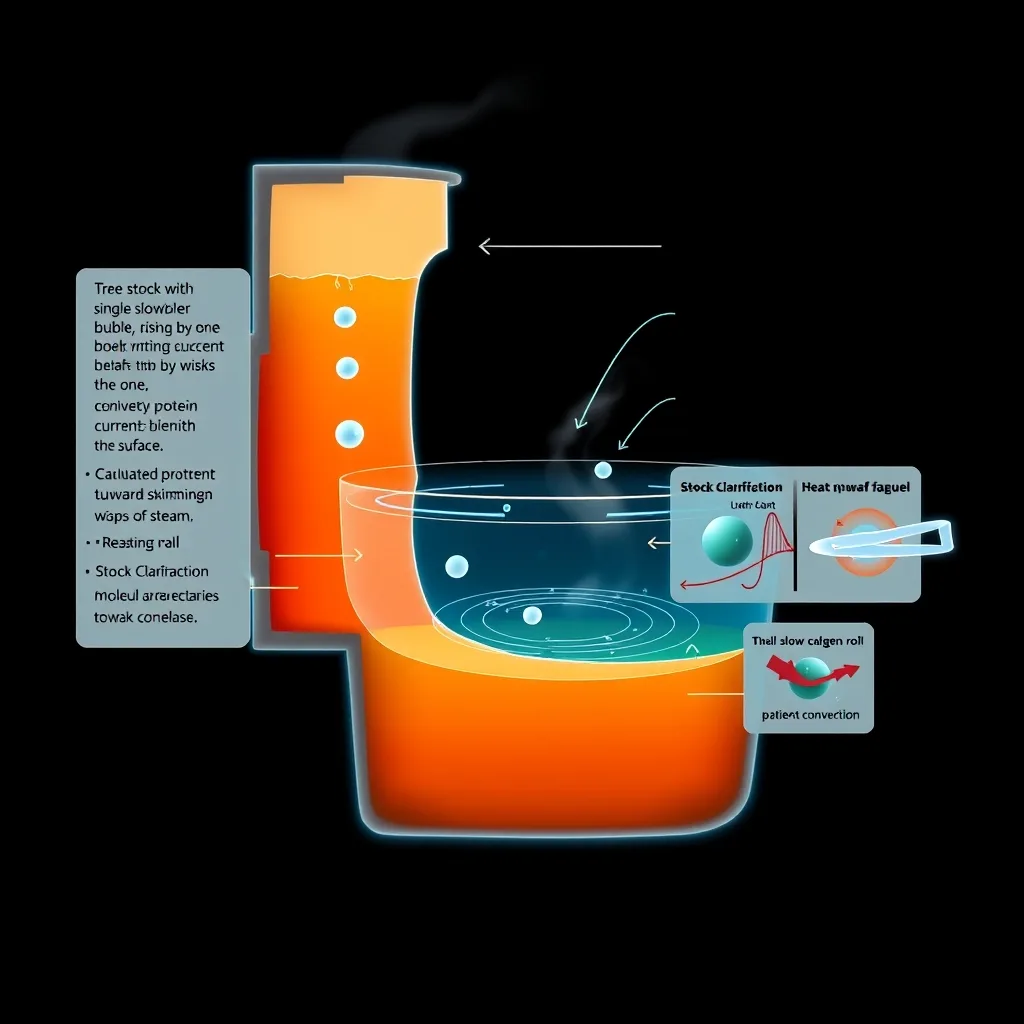
The discipline of the threshold: a medium held at the very edge of the boil, where single bubbles rise slowly and extraction proceeds without destruction.
KINETIC_PROFILE
Voltage rides just beneath the phase ceiling; current circulates in slow, continuous loops. The system is a controlled extraction column — energetic enough to dissolve, restrained enough to clarify.
k = A · e^(−Ea/RT)Arrhenius — extraction rate climbs with temperature yet stays below the agitation that clouds the medium.
ELEMENTAL_SIGNATURE
This transmutation leans water.
ASTROLOGICAL_RULERSHIP
MOLECULAR_INTERACTION
Stock Clarification
At the sub-boil, coagulated proteins raft on the surface instead of being churned back into suspension. The column below runs clear — the difference between consommé and cloud is a handful of degrees.
Slow Collagen Conversion
Hours at the threshold convert connective tissue to gelatin without shredding muscle fibers — the long braise's open-vessel sibling, trading enclosure for evaporative concentration.
THERMAL_ENVELOPE
Below full boil for controlled extraction/reduction and tenderization.
PRAXIS
BENEFITS
- gentle heat extraction
- flavor preservation
- tenderizing tough cuts
- even cooking
- reduced risk of overcooking
- minimal agitation for delicate items
- consistent temperature control
- extraction of flavors without violent agitation
SUITABLE_SUBSTRATES
INSTRUMENTS
- Heavy-bottomed pot or Dutch oven
- Heat source with good control
- Thermometer (recommended)
- Heat diffuser (optional)
- Lid
- Wooden spoon
- Ladle
- Skimmer
- Timer
- Heat-resistant gloves
COMMON_FAILURES
- allowing temperature to reach a full boil
- insufficient liquid
- impatience (rushing the process)
- overcrowding the pot
- excessive stirring (disrupts gentle process)
- irregular heat (fluctuating temperatures)
- using pots with poor heat distribution
- not adjusting for altitude
REGIONAL_VARIANTS
- FRENCH mirepoix base for stocks, court bouillon for poaching, bourguignon technique, cassoulet slow cooking
- ITALIAN sugo sauce simmering, risotto broth incorporation, minestrone technique, osso buco preparation
- ASIAN dashi stock preparation, congee slow cooking, hot pot variations, clay pot simmering techniques
- INDIAN dal preparation methods, curry slow-cooking, sabzi techniques, spice blooming in liquid
- MIDDLE EASTERN tagine cooking, slow-cooked rice dishes, harira soup technique, lamb stewing methods
OPTIMAL_TEMPERATURES
SAFETY_SIGILS
- Lower temperature reduces risk of burns compared to boiling
- Less splashing than rapid boiling
- Requires monitoring but less intensive than high-heat methods
- Important to maintain food safety temperatures for meat (above 140°F/60°C)
- Handle pot lids carefully to avoid steam burns
- Use proper ventilation
ARCHIVES
HISTORICAL_RECORD
Simmering is one of humanity's earliest refined cooking techniques, developed once humans mastered controlled fire and created vessels that could withstand heat. Archaeological evidence suggests controlled simmering dates back to at least 10,000 BCE. The technique was refined in ancient civilizations like China, where clay and bronze vessels were specifically designed for slow cooking. In medieval Europe, the cauldron suspended above a hearth allowed for precise simmering control. The technique gained scientific understanding during the 18th century with advancements in thermodynamics. Traditional cultures worldwide developed specialized simmering vessels, from the Moroccan tagine to the Japanese donabe, each designed to maintain ideal simmering conditions for regional cuisines.
SCIENTIFIC_PRINCIPLES
- Convection currents distribute heat throughout liquid without violent agitation
- Simmering temperature range (185-200°F/85-93°C) maximizes flavors while minimizing protein toughening
- Gentle heat breaks down connective tissues in meat (collagen) to gelatin without excessive protein contraction
- Subcritical temperature prevents rapid evaporation while allowing gentle reduction
- Surface tension creates characteristic small bubbles breaking at surface
- Vapor pressure balanced with atmospheric pressure creates stable temperature
- Gentler protein denaturation preserves moisture and tenderness
- Solubility of compounds varies with temperature, affecting extraction rate